Delivering better collections outcomes
A guide to driving commercial and customer success
Does your existing system undermine your collections performance?
As a collections leader, you are under intense pressure to hit commercial targets – improving net recovery rates and lowering your cost-to-collect – while navigating the complex, high-stakes demands of Consumer Duty.
But, underperforming collections systems and traditional ‘call-first’ processes weren't built for the modern operating environment. They create negative friction, drain resources, and force your agents into a high-cost, low-efficiency model, making it nearly impossible to satisfy both goals at once. They are:
- High-Cost: Wasting expensive agent time on routine tasks, which inflates your cost-to-collect.
- High-Risk: Failing Consumer Duty by lacking the flexibility to prevent foreseeable harm.
- Low-Return: Creating friction and anxiety that drive disengagement – the ultimate barrier to resolution.

Driving collections performance through customer success
A customer-centric approach helps you meet these commercial challenges. It's built on a simple, proven principle: the most profitable and sustainable collections strategy is to excel at customer success.
Your biggest commercial levers are no longer just your agent call lists. They are empathy, convenience, and choice. This isn't a soft idea. It is customer-focused, but it's also an astute commercial strategy. When you focus on solving the customer's problem, you also solve your own.
How empathy drives collection rates
In this guide, we’re taking a different look at empathy and how, at scale, it can be a driver of efficiency. A process that feels sterile, robotic, or judgmental can cause customers to disengage. A supportive, respectful, and non-judgmental process builds trust. Trust is the currency of engagement, and engagement is the only way to get a sustainable recovery.
Task
The old way (manual)
The new way (automated)
Reducing the cost-to-collect with convenience and choice
If your collections operation relies on a 9-5 call centre as its front door, your cost-to-collect is artificially high. This single operational choice leads to staggering inefficiency. You are ‘closed for business’ when 70% of your customers are available. You are frustrating them, funnelling them into high-anxiety phone calls, and failing the most basic test of Consumer Duty. It worked in the past, but today, it’s the most expensive and least effective way to run a collections department.

Do you have a negative friction problem in collections?
Your collections process is likely to be full of negative friction – digital dead-ends, 9-5 call centres, data lags and agents without enough information. This frustrates good customers and costs you a fortune.
Take our 60-second test to get your Collections Friction Score and a personalised report on what to fix first.
Turning strategy into action
A winning philosophy is nothing without practical advice. This helps your strategy become a reality.
Here’s an inescapable truth: an outcomes-driven approach is impossible to deliver on inadequate or outdated technology.
Your strategy is held hostage by your system's limitations. You can't be data-driven if your data is 24 hours old. You can't offer choice if your portal is just a payment screen. And you can't deliver empathy at scale if your agents are working from poorly informed, inconsistent scripts.
The following guides are your next step. They provide the 'how-to' frameworks for implementing this model, from managing customers to replacing your core technology.
Real-time data: The key to fair and consistent outcomes
It’s much harder to deliver a good outcome if your data is 24 hours old. Calling a customer who paid online last night is a critical failure.
A real-time system, where all interactions are timely and appropriate, is the non-negotiable foundation for any modern strategy.
Read the guide: Why overnight batching is your biggest cost (and how real-time data fixes it)
Beyond segmentation: How sophisticated, real-time decisioning drives better outcomes
A one-size-fits-all approach is a compliance risk and a commercial drain. However, basic segmentation is no longer the finish line – it is the starting point.
Optimal performance comes from moving beyond static groups to real-time decisioning. By layering predictive analytics and behavioural triggers, you can align your strategy with a customer’s immediate reality. This allows you to deploy frictionless digital journeys for low-risk accounts while reserving your human experts for the complex, sensitive cases.
This guide explores the evolution from simple segments to dynamic orchestration, helping you eliminate wasted effort and meet Consumer Duty standards with precision.
Read the guide: From segmentation to sophisticated decisioning
Optimising customer engagement with data-driven testing
Putting customer outcomes at the centre of your collections process means taking a data-driven approach. You stop using gut feel to drive your recovery rates and start knowing what works.
This practical guide shows you how to use Champion/Challenger testing to find the exact strategies, language, timing, and channels that improve engagement and collect more. This is the engine of continuous improvement, and it's a shift that a modern software solution allows you to make without a dedicated IT team.
Read the guide: Optimising collections strategy with Champion/Challenger testing
A strategic guide to replacing your debt collection system
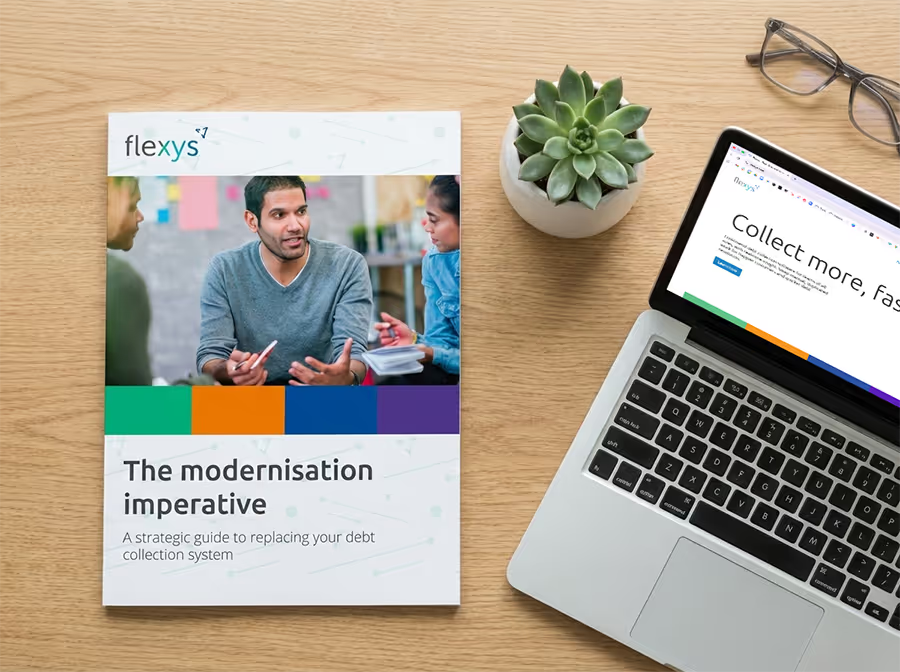
For most collections leaders, the primary barrier to results is their legacy debt management system. It has become the bottleneck blocking every new strategy and sapping your team’s innovation.
You can’t be data-driven, real-time, or digital-first on a system built for batch files and legacy diallers. Real-time customer success requires a modern technology engine.
Overcoming the Digital Collections Gap
The cost of doing nothing now surpasses the cost of change. With financial institutions spending 75% of IT budgets just to "run" outdated estates, legacy maintenance is a strategic liability.
This guide is for decision-makers building the business case for change.
It provides a comprehensive framework to benchmark your current system and evaluate your path to modernisation.
Prioritising customer outcomes for long-term business growth
Promoting positive customer outcomes is the foundation for high-performing collections.
It is the only framework that delivers on all four key pillars of a successful operation: improving debt resolution for customers, collecting more, spending less, and reducing risk.
When you make customer success your goal, sustainable, long-term ROI is the natural result.
Ready to see the outcomes model in action?
Book a no-obligation demo to see how Flexys' software can drive customer success and commercial performance.

.webp)
.png)