The three psychological hooks of debt engagement
Beyond the "Escape Yes": Using Behavioural Science to Transform Debt Engagement
In debt collection, the traditional compliance-led model is hitting a ceiling. While spreadsheets can calculate what a customer should pay, they often fail to account for the cognitive tax of financial stress. Research indicates that significant debt and financial worries can cause a temporary reduction in functional IQ of approximately 13 points. This is the equivalent of a night of total sleep deprivation or the effects of chronic alcoholism.

When customers operate under this level of strain, they need a collaborative bridge rather than another demand. To move a customer from passive processing to active ownership, lenders must move beyond the "Escape Yes", which occurs when a customer agrees to a plan just to stop the immediate discomfort of the interaction, rather than because the plan is sustainable.
True engagement is built on three psychological hooks: empathy, concretisation, and reciprocity.
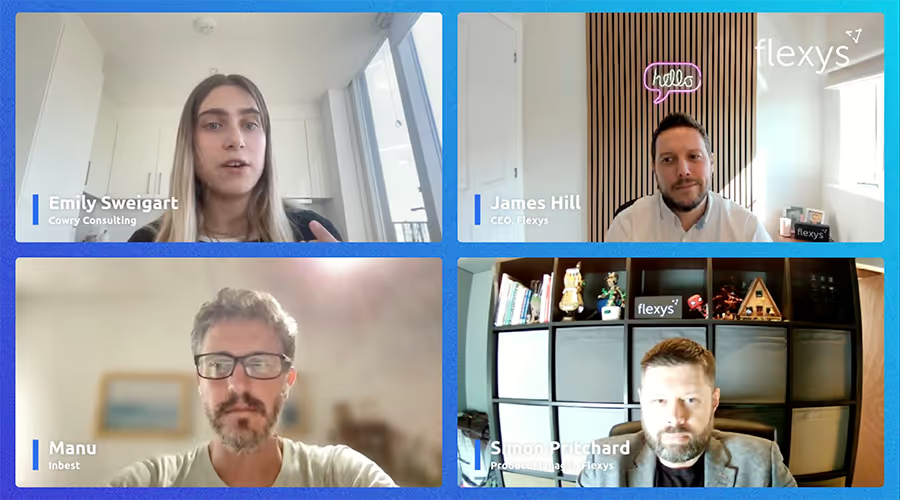
"We are not an infinite well of computing power and rational decision making... our bodies will always want to expend the least amount of energy possible in order to ensure our survival."
Emily Sweigart, Senior Consultant, Cowry Consulting
1 Start with empathy to open the door
The first barrier to engagement is frequently fear and anxiety rather than a lack of funds. In a state of Ostrich Politics, customers bury their heads in the sand because the issue feels too cognitively taxing to face. According to the Financial Conduct Authority (FCA), 92% of people with low financial capability feel unconfident when dealing with money or financial matters, which often leads to total avoidance.
An empathy-led approach is a deliberate operational strategy that yields measurable ROI. By softening opening touchpoints and using supportive language, organisations can reduce the perceived threat and bypass the brain's natural urge to conserve energy by ignoring the problem. A Cowry Consulting project with Southern Water demonstrated the power of this shift, seeing a 12.8% reduction in process duration and a 23.7% increase in successful closures by simply prioritising the customer's emotional state at the start of the journey. To achieve this, organisations should position themselves as a supportive partner, replacing aggressive red-ink demand letters with communications that acknowledge the difficulty of the situation.
2 Use concretisation to make options real
A major cause of disengagement is asymmetrical information, where customers do not understand their options or the true impact of their choices. To solve this, lenders must use concretisation, which involves bringing features to life in tangible, relatable ways.
Asking a customer if they want an income maximisation review can feel like adding another chore to a heavy mental load. The value must instead be framed through the lens of their actual life. Consider the way technology is sold: a 48-megapixel camera means little to most people, but a camera that takes crystal clear images of your family creates an immediate emotional connection. Lenders can apply this by framing payment plans and support tools by how they tangibly affect the customer's lifestyle. Instead of discussing arrears reduction, the conversation should focus on protecting the home or regaining peace of mind.
"The best approach is that the creditor is showing that willingness to contribute positively to the situation."
Manu Peleteiro, Founder, Inbest.ai
3 Build trust through early reciprocity
Humans are hardwired for reciprocity. We are sensitive to perceived acts of kindness and service, yet in a standard collection journey, the interaction is often entirely one-way. This creates a massive motivational barrier to entry.
To trigger reciprocity, the lender should provide value before asking for it. This ‘scratch my back’ mentality builds a network of trust that is essential for a social species. Offering a benefits calculator, such as Inbest, is a prime example of this. With roughly £24 billion in income-related benefits going unclaimed annually in the UK, helping a customer uncover this income provides a gift of extra financial resilience. For the best results, the lender should own this journey within their own digital space to ensure quality control and better reporting under Consumer Duty.
Understanding the IKEA Effect: Why collaboration matters
The ultimate goal of using these hooks is to trigger a psychological phenomenon known as the IKEA Effect. This concept stems from a study where participants who built their own origami cranes valued them significantly higher than those who were simply handed pre-made ones. We value our own effort and input far more than something that comes pre-fabricated to us.
In a debt context, a plan handed to a customer by a creditor is a plan with no emotional value. However, when a customer has psychological input and investment in building the plan, they perceive it as being worth more. This bypasses Ostrich Politics because the customer now feels like an expert in their own plan, leading to a much higher level of commitment and engagement.
Powering collaboration through Flexys
Translating these psychological hooks into a live environment requires more than just a change in tone; it requires a specialised technical framework. This is where the Flexys software moves from a record-keeping system to a high-performance engagement engine.
To trigger the IKEA Effect, a system must move away from rigid, linear processing. Flexys allows lenders to build dynamic, self-service journeys where customers are not just clicking accept, but are actively configuring their own solutions. By offering clear, well-defined choices at the right point in the journey, the software enables customers to feel like experts in their own financial recovery.
Operationalising empathy and reciprocity at scale also demands sophisticated segmentation. Flexys uses real-time data to organise customers into similar groups based on their arrears level, history, or even their specific answers to previous questions. This allows the lender to offer a tailored experience, such as an integrated income maximisation tool for a vulnerable customer, while allowing a different user to simply make a quick payment at 1AM.
Crucially, this collaborative approach is also a compliance safeguard. Under Consumer Duty, firms must evidence that they are helping customers avoid foreseeable harm. Because Flexys records not just the final outcome, but every action and decision available to the customer throughout the journey, lenders have a systemised way to prove they are treating people fairly. Ultimately, the software acts as the bridge between psychological theory and operational reality, ensuring every interaction is a mutual investment that protects both the customer’s wellbeing and the lender’s recovery rates.
With thanks to Emily Sweigart, Cowry Consulting
For more discussion of this subject, watch our webinar "From passive processing to collaboration".