Customer-centric collections: what we heard at Credit Week
AI in the hands of customers, structural affordability pressure, and why Variable Recurring Payments are worth a closer look.
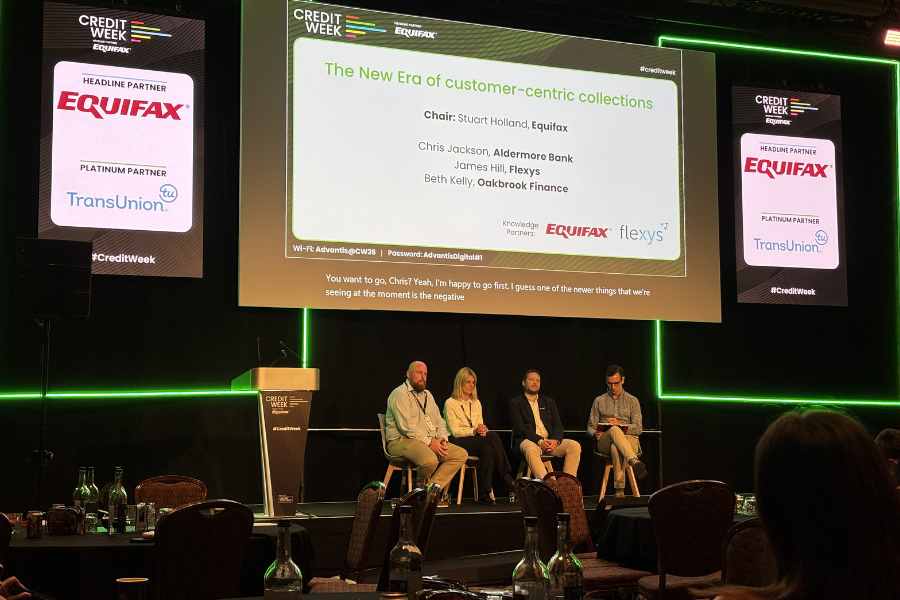
At Credit Week, our CEO James Hill joined a panel on the new era of customer-centric collections, alongside collections and compliance leaders from Aldermore Bank and Oakbrook Finance. It was an honest discussion of what's hard in collections right now, and what's actually working.
Here's what stood out, and what it means for lenders managing customers in arrears.
Customers are arriving pre-briefed by AI
One of the clearest shifts is that customers now turn to ChatGPT and similar tools before they speak to you. They arrive with letters and complaints that sound formal and legalistic, and that sometimes carry confident misinformation. It creates work, and it can make the conversation harder.
But it points somewhere useful. People reach for AI because the original paperwork didn't make sense to them. Credit agreements run to eight pages in language few customers can follow. If someone uses a tool to understand what they've signed up to, that's a better outcome than advice picked up on social media.
The lesson is to explain the collections journey in plain English, and earlier, so customers feel less need to fill the gap themselves.
The fundamentals still aren't solved
For all the talk of new tools, the core job hasn't changed. How do you get a customer to open a message and respond? How do you turn a difficult conversation into one that keeps the relationship intact?
The environment moves fast. Complaints spike after a Martin Lewis mention. Regulation keeps shifting. But the basics of engagement and clear communication are still where most of the value sits. Chasing the newest thing rarely helps if those aren't right.
Affordability pressure is structural, not a spike
The cost-of-living squeeze has eased out of the headlines, but it hasn't gone away. Limits are lower, balances take longer to clear, and customers have less room to settle quickly.
That changes the shape of collections. Arrangements run longer, relationships run longer, and lenders should build affordability into the standard journey rather than treat it as an exception for the few. In practice that means affordability checks and flexible repayment options in the default process, not bolted on afterwards, and planning for longer arrangements from the start. It also means managing risk over a longer horizon.
VRPs: a faster, more flexible option for early arrears
One theme worth drawing out is Variable Recurring Payments (VRPs). A lender on the panel has introduced them as an option within its forbearance journey, and the logic holds up well for arrears.
VRPs run on Open Banking, so the cycle is shorter than Direct Debit and access to forbearance can be faster. Customers who are paid weekly, or who have an irregular income, can match payments to when money actually lands in their account. They set the limits up front, and they can see and cancel the consent in their banking app, which gives them a level of control that Direct Debit and card-on-file don't.
The barrier is awareness, not capability. The term "variable recurring payment" can sound alarming to a customer who hears it as open-ended access to their account, so naming and clear explanation matter. Offered as a genuine choice, with the limits and controls made plain, a VRP becomes another route to an affordable, sustainable arrangement, and a useful answer to the weekly-paid and irregular-income customers that fixed Direct Debits serve poorly.
We looked at this in detail in our webinar, Smarter collections: Unlocking VRPs for better outcomes and customer experience, with Lawrence Byers (Acquired.com) and Simon Pritchard (Flexys). It covers why traditional payment methods create friction, how VRPs work in practice, and where lenders are already using them.
What's working: treat people differently
The strongest theme on solutions was tailoring. The reason a payment failed matters. An expired card is not the same as an empty account, and the message should reflect that. One is a quick prompt with a link to update details. The other needs care.
Risk-based treatment means not pushing a medium-risk customer down a high-effort path they don't need. Done well, this doesn't cost more. Modern collections software makes it quicker to build, test and adjust these journeys, and to step back when something isn't landing. This is exactly what dynamic, personalised self-service journeys are designed to do.
There's also a shift in the value exchange. Real-time affordability and benefits checks can find a customer money they didn't know they were owed. That turns the interaction from taking something to giving something, which changes how a customer responds.
AI inside the operation
The most useful applications today sit on the data and analytics side: faster insight, anomaly detection, and the segmentation that makes tailored journeys possible.
The other clear win is the unglamorous back-end work. One agency found its most sceptical, highest-performing collectors were won over by AI handling the call write-up. Take a chore off the team and they notice when it's gone.
The case for investing in collections
Collections often sits at the later end of the budget, behind acquisition and marketing. That's a misnomer. Anyone can lend money out. Collecting it back is what keeps a business solvent, and finance directors know it.
The case is financial and logical. Money recovered can be reinvested in new lending and new products. Even a small improvement in arrears performance pays for itself.
Three things to take back to work
- Be clear about the outcome you want, then measure whether you're getting it. Don't reach for the shiny tool that's too far from where you are today.
- Design journeys around the customer, not your own convenience. Bring people with diverse experience into the design, including those who've been in arrears themselves.
- Don't wait for regulation to settle before improving. The lender that went early on VRPs is learning as it goes, and improving as it learns.
This is the work we build for. Flexys gives UK lenders the collections software and digital self-service to engage customers earlier, tailor treatment to circumstances, and resolve early arrears in a way that protects the customer relationship and the book at the same time.
.png)

.webp)

.png)